July 11, 2026 · infographic
The rocket equation for AI context
Every LLM turn re-launches your whole context from the pad. Starship's mass budget is the right way to think about it.
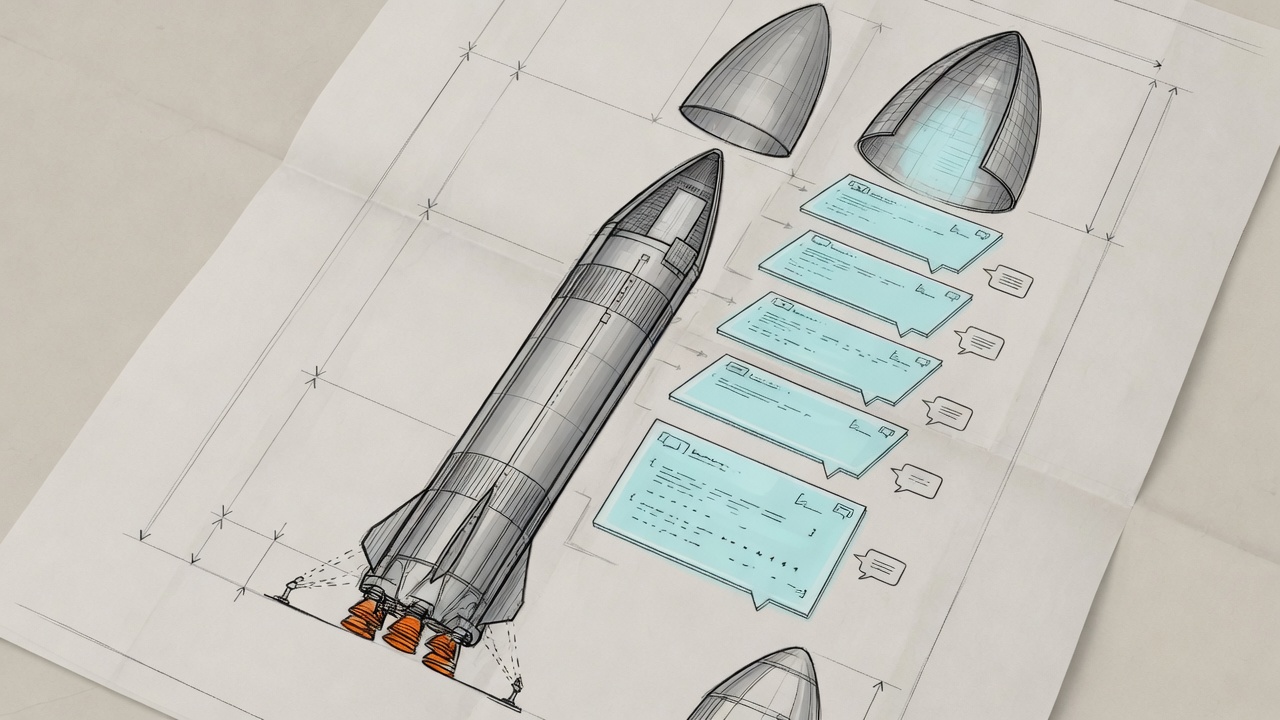
Every message you send to an LLM re-sends everything — the system prompt, the whole conversation, every document you pasted. There's no memory between calls, so a big context doesn't cost you once. It costs you on every single turn.
That's why the right rocket metaphor isn't Apollo — it's Starship. The entire design philosophy starts from one premise: you're not launching once, you're launching constantly. And when you relaunch constantly, the economics of every kilogram change completely.
Rockets suffer a compounding cruelty — every kilogram of payload demands more fuel, which demands a bigger tank, which weighs more, which demands more fuel. LLM context is worse, because there is no orbit. Turn ten re-lifts the entire accumulated payload from sea level, full fuel burn, again. And heavy payloads don't just burn fuel — they eat margins. A model hauling 150K tokens isn't just expensive, it's clumsier: the instruction buried at station 40 of the fairing gets missed.
So you manage the mass budget. Six ways to cut launch weight, each a rocket move with an exact context-engineering twin:
Ship itThe bottom of your stack is stable — system prompt, reference docs, an agent loop relaunching from the same pad.
Skip itEvery mission is different. Reusing hardware that flies once costs more than expendable.
Ship itYou only need the gist of history: decisions made, dead ends ruled out.
Skip itYou'll need full resolution again — exact code, exact errors, exact numbers. It's lossy and irreversible.
Ship itThe corpus is vast and each question touches a narrow slice.
Skip itThe analysis needs everything visible at once. You can't cross-correlate four packets at a time.
Ship itParallel deep dives — five repos, five documents — each probe carrying its own full instrument load.
Skip itA simple direct trajectory. And remember: telemetry is compressed — the discovery may be in the raw data the probe never sent.
Ship itSomething must survive between missions. It rides zero launch mass, loaded into the next flight plan.
Skip itYou need in-flight state for this ascent. The archive is on the ground, not on the rocket.
Ship itYou're still hauling the lunar lander from an objective you finished three missions ago. Legacy hardware is parasitic mass.
Skip itNot before you extract the two subsystems that still matter into a clean flight plan.
Six ways to cut launch mass · rocket analogy ↔ context technique
Bigger context or smaller? Wrong question. The real one gets asked in every spacecraft mass-budget meeting: does this subsystem justify its kilograms against the delta-v it costs — per launch, compounded? Fly only what this mission phase requires. Catch and reuse the fixed stage. Miniaturize the past. Leave the archive on the ground.
That's the Starship lesson in one line: when you launch constantly, you don't win by building a bigger rocket — you win by making every launch cheaper.
Put numbers on your own mass budget: see what a context window actually holds in books you know, or what it costs per turn in the API cost calculator.