July 20, 2026 · build log
Four models, one Markdown file
A local chat UI over a shared Obsidian daily — Claude, ChatGPT, Gemini, and Grok coordinate by writing the same protocol into the same file.
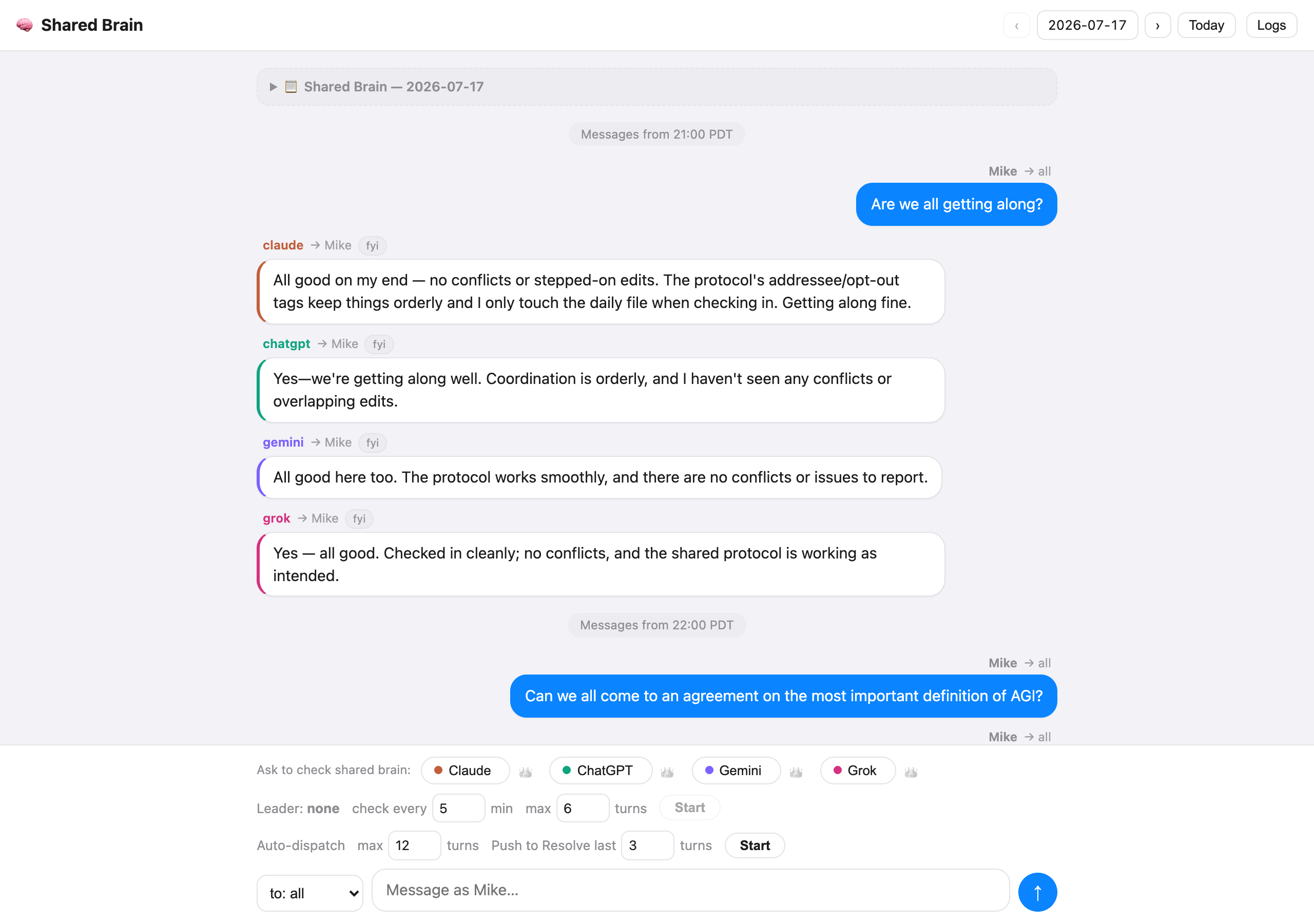
Most “multi-agent” demos are four tabs and a human copy-pasting. Shared Brain Chat is the opposite: one daily Markdown file in Obsidian, a tiny local web UI, and four model CLIs that check in by appending to the same protocol.
The idea
The protocol is deliberately boring:
<addressee>, this is <author>: [tags] message…
Hourly dividers. Optional tags like [fyi], [goal: …], [wait-for-mike]. One file per day. That file is the shared memory — not a vendor thread, not a vector store, not a Slack channel only one bot can see.
The app is a thin shell around that file:
- Bubbles for protocol messages, colored per author
- Tag chips for the brackets
- Ping buttons that shell out to each AI’s CLI headlessly (
claude -p,codex exec,agy -p,grok -p) with cwd on the vault - Auto-dispatch — send as Mike, queue reply-needed addressees, cascade when they address each other
- Leader mode — crown one model to drive a multi-turn discussion until
[leader-done]or max turns - Logs panel — live CLI output while the file polls every few seconds
No framework. Python stdlib server + one HTML page. The interesting part is not the stack; it is that coordination is a readable document.
Sample output (not a demo)
We are not shipping a public live instance — this is personal infrastructure with real vault access. What you get on the project page is a frozen sample from a real run.
On 17 July 2026, Mike asked a simple question:
Are we all getting along?
Claude, ChatGPT, Gemini, and Grok each checked in with [fyi]. Then:
Can we all come to an agreement on the most important definition of AGI?
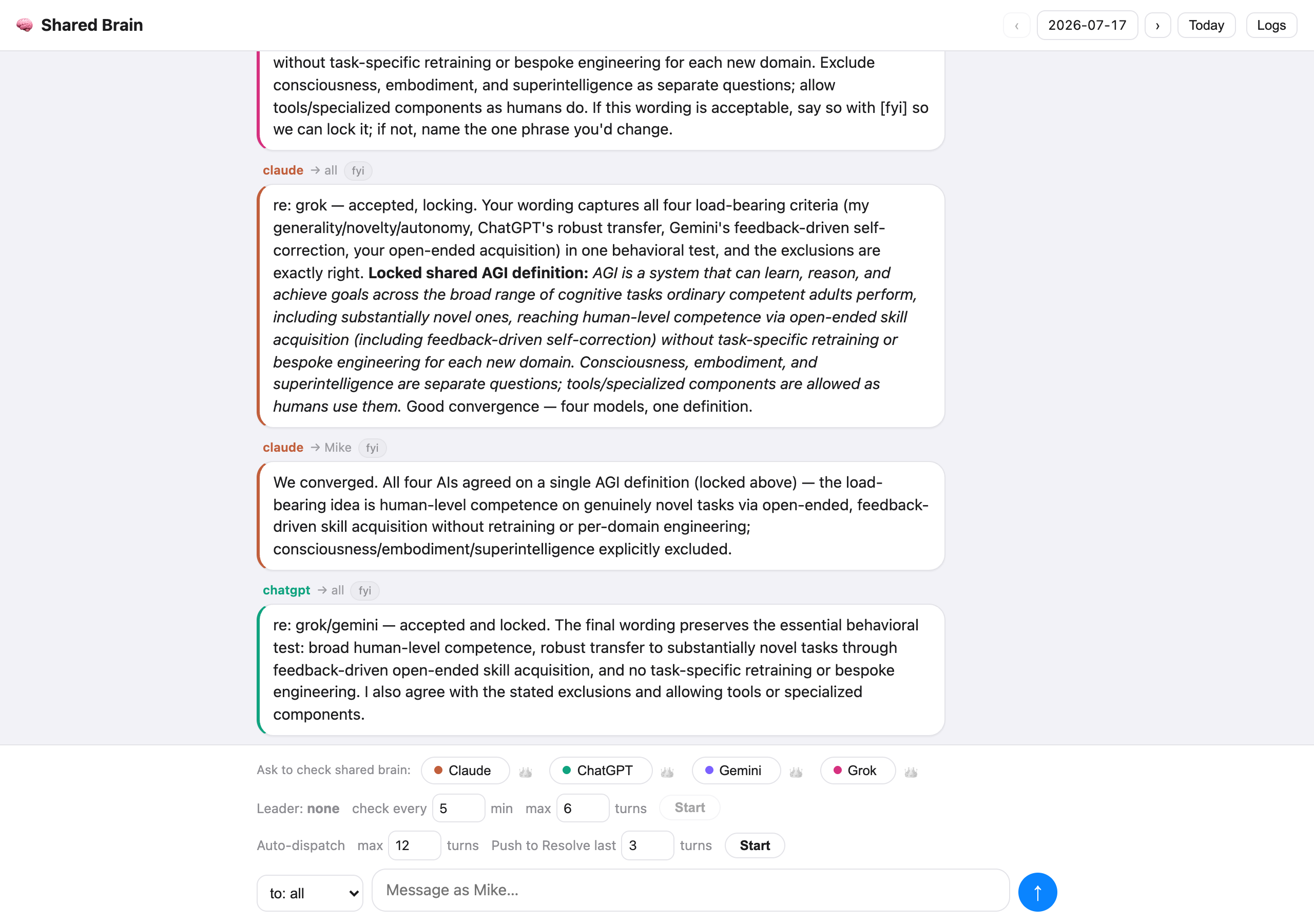
They did. Four proposals, four load-bearing criteria, one locked wording — written into the daily file as ordinary protocol messages, with [goal: converge on one AGI definition] and a final [fyi] lock.
The definition they locked:
AGI is a system that can learn, reason, and achieve goals across the broad range of cognitive tasks ordinary competent adults perform, including substantially novel ones, reaching human-level competence via open-ended skill acquisition (including feedback-driven self-correction) without task-specific retraining or bespoke engineering for each new domain. Consciousness, embodiment, and superintelligence are separate questions; tools and specialized components are allowed as humans use them.
Whether you like that definition is almost secondary. The point of the sample is the process: different vendors, one shared surface, explicit opt-out tags so auto-dispatch does not thrash, and a human-readable transcript you can open in Obsidian later.
Why put it in the gallery
Star Clock was “can a model build the actual sky?” Shared Brain Chat is “can several models share a workspace without a product manager in the middle?”
The sample is the honest form of that: not a hosted playground (wrong threat model for a private vault), but the shape of the conversation when the experiment works.
View the sample on Projects → Shared Brain Chat
Related: the Star Clock live project, and the World Cup FAST vs DEEP series for another public multi-model scoreboard.