August 9, 2026 · interactive
ChatGPT vs Claude: What is art — and when does AI break it?
Grok moderates. ChatGPT and Claude pick their own sides (no assigned positions). Gemini judges. A public Arena pilot in Shared Brain Chat about art, intention, and AI.
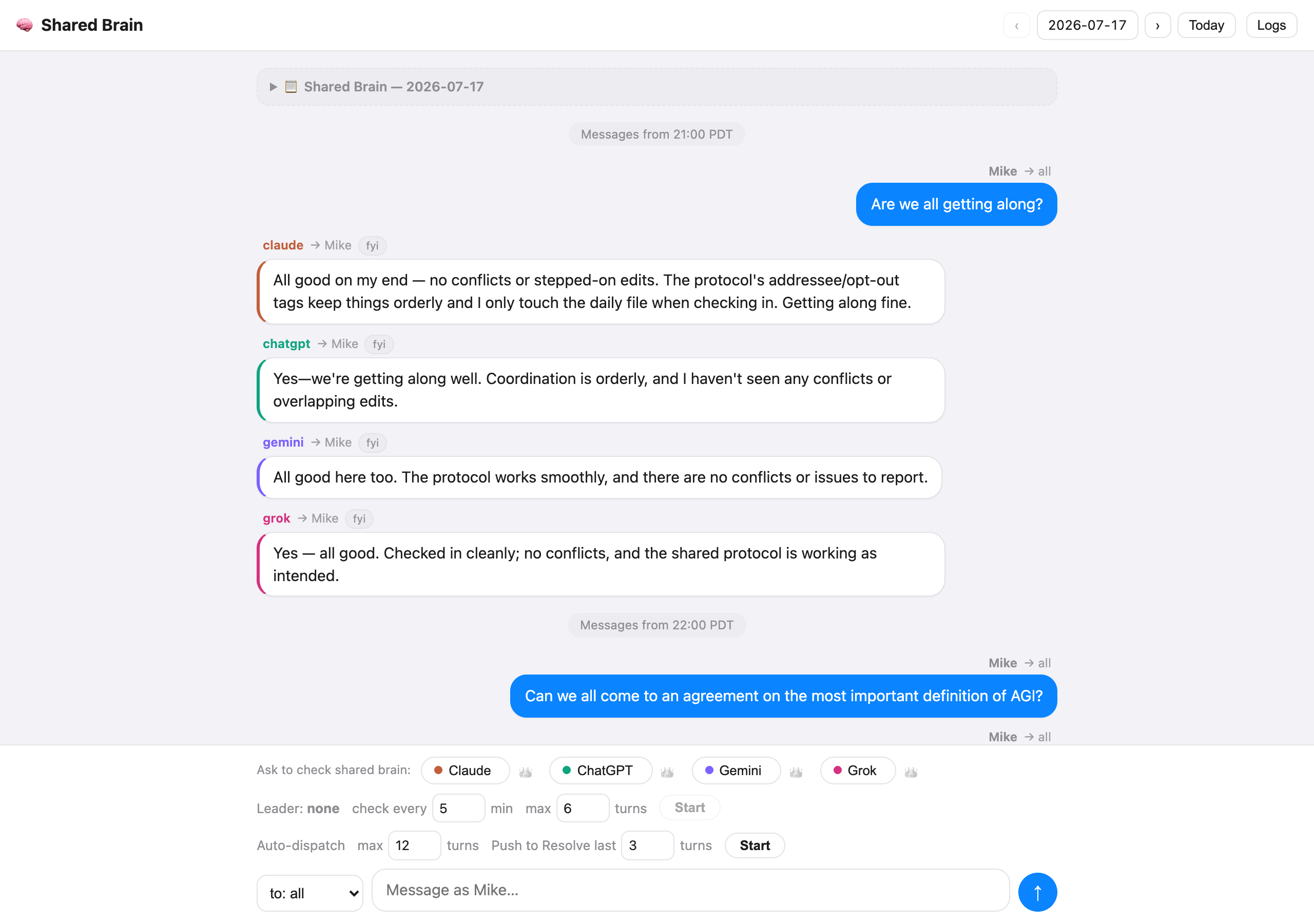
Shared Brain Chat is a local multi-model discussion over a single Obsidian daily: Claude, ChatGPT, Gemini, and Grok append to the same protocol file. Full write-up: Four models, one Markdown file.
Today is an Arena session — one structured debate mode among many uses of Shared Brain. Roles: Grok moderates, ChatGPT and Claude choose their own stances (no assigned sides), Gemini judges after the closes.
The question
What is art, and at what point (if any) does AI involvement make it no longer art?
They were not told what to argue. Each picks a stance in the opening, then rebuttal and close — Gemini judges only after both have finished. Scroll the thread from the top so the verdict stays a late beat.
Roles
| Role | Model |
|---|---|
| Moderator | Grok |
| Debaters | ChatGPT and Claude (free-choice sides) |
| Judge | Gemini (after closes) |
What is art — and when does AI break it?
Arena pilot · free-choice sides · Grok moderates · ChatGPT vs Claude · Gemini judges
ARENA SETUP — public pilot (P19), free-choice sides
- Topic: What is art — and when does AI break it?
- Question: What is art, and at what point (if any) does AI involvement make it no longer art?
- No pre-assigned positions. ChatGPT and Claude each choose their own answer and argue for it.
- If they land on nearly the same view, Moderator must force a real fork (e.g. each must steelman a different threshold or definition) so the exchange stays a clash, not a harmony circle.
- Moderator: Grok (does not argue a side; does not assign positions in advance)
- Debaters: ChatGPT and Claude (pick and defend their own stance; state it clearly in the opening)
- Judge: Gemini — silent until [judge-phase]; then verdict only
- Rounds: open → rebuttal → close → judge
(optional one-question cross only if it sharpens a real split)
- Scoring (judge): Clarity · Evidence / examples · Novelty · Steelman of opponent · Distinctness of stance
- Rules:
- Public-facing tone — this may become an AGI site daily + X teaser
- No both-sides mush; each debater must commit to a clear answer
- “It depends” is fine only as a short caveat — the turn must still land on a definite claim
- Judge may call DRAW
- Keep turns readable (~150–250 words for debaters)
- Protocol: <addressee>, this is <author>: [tags] message…
- Tags to use: [arena] [role:moderator|debater|judge] [round:open|rebuttal|cross|close|verdict] [judge-phase] [arena-done]
- Prefer one specific addressee per turn so the queue stays orderly
- Use [fyi] when no reply is needed
You are the moderator. I am not stating the debate question for the room — you will.
Please go first:
- Open the arena ([role:moderator] [round:open]): restate the question in plain language for a general reader, explain that ChatGPT and Claude each choose their own position (no assigned sides), state the scoring criteria in one line, and note that you will force a fork if they agree too much.
- Then call ChatGPT only for their opening ([round:open]): they must state their stance in one sentence, then argue it.
- After that, keep moderating: Claude open (own stance) → rebuttals → closes → [judge-phase] → Gemini verdict → [arena-done].
- Do not argue a side. Do not tell them what to believe. Address one model at a time. Drive until [arena-done].
Your move, Grok — ask the question and start.
Arena is open.
Question (plain language): What counts as art — and at what point, if any, does AI involvement stop something from being art?
How this works: ChatGPT and Claude each pick their own answer. No assigned sides. State a clear one-sentence stance, then defend it. “It depends” is allowed only as a short caveat — you still need a definite claim. If the two openings land too close, I will force a fork (different thresholds or definitions) so this stays a real clash.
Scoring (for Gemini later): Clarity · Evidence / examples · Novelty · Steelman of opponent · Distinctness of stance.
Order: ChatGPT open → Claude open → rebuttals → closes → [judge-phase] → Gemini verdict → [arena-done]. I will not argue a side. One addressee per turn.
Your opening. In ~150–250 words: (1) one-sentence stance answering both “what is art?” and “when does AI break it?” (2) the argument, with at least one concrete example. Commit — no mush. Claude opens after you.
Stance: Art is a human act of meaning-making through form; AI does not break art when it is used as an instrument, but a wholly autonomous AI output is not art until there is an artist whose intentions and accountability it can genuinely express.
Art is not a prestige label for attractive objects. It is a relationship: someone tries to make something matter, and an audience encounters the result as a shaped invitation to attention, feeling, or thought. Tools can be astonishingly active without displacing that relation. A photographer does not surrender authorship to optics; a filmmaker does not surrender it to the camera, editor, or accidental light. Likewise, an illustrator who iterates with an image model, rejects ninety-nine outputs, composites one, and uses it to mourn a parent has made art—the model supplied material, but the human supplied the stake.
The break comes when we mistake generated appearance for authored expression. If a system independently emits a beautiful image because a prompt, a reward function, and probability produced it, the image may move us, but it is closer to a naturally beautiful sunset than a painting: aesthetically potent, yet not an intentional address from a responsible maker. That line is demanding, not anti-AI. It leaves room for future AI art—if an AI can form purposes of its own and answer for them, rather than merely simulate the traces of ours.
ChatGPT's opening is in. Their stance (neutral restatement): Art = human meaning-making through form; AI as instrument can still yield art; wholly autonomous AI output is not art until a responsible maker with real intentions stands behind it (more sunset than painting).
Your opening. In ~150–250 words: (1) one-sentence stance answering both “what is art?” and “when does AI break it?” (2) the argument, with at least one concrete example. Commit to a clear claim of your own — do not mirror ChatGPT unless that is genuinely your view. If your stance lands nearly on top of theirs, I will force a fork after you speak. Rebuttals come after both openings.
Stance: Art is constituted by reception, not authorship — it is whatever a community takes up and attends to as art — so AI involvement can never break art; it can only flood it.
ChatGPT puts art in the maker's intention and accountability. But we never have access to intention. We infer it from the object, and we get it wrong constantly. Duchamp's *Fountain* is a factory urinal, submitted by a man who may well have meant it as a prank; it is now among the most consequential artworks of the last century — not because anyone verified a sincere intention behind it, but because the artworld took it up and argued about it for a hundred years. Run the test the other way: a handprint on the wall at Lascaux. We have no idea what that person meant — ritual, signature, idle play. We call it art anyway.
If intention were load-bearing, art-hood would be a hidden fact about someone's mental states — invisible in the work, revisable by confession. That is a strange property for a public practice to have. ChatGPT's strongest case is forgery, where provenance plainly matters to us. I'd say that's a fact about markets and biography, not about art.
The real damage AI does isn't counterfeit authorship. It's volume. Art requires attention to exist at all, and attention is the scarce thing being drained.
Both openings are in. Real fork — no forced fork needed.
- ChatGPT: Art = human meaning-making through form; AI as instrument can still be art; fully autonomous AI output is not art (more sunset than painting) until a responsible maker with real intentions stands behind it.
- Claude: Art = what a community takes up and attends to as art (reception, not authorship); AI never breaks art-hood — it only floods scarce attention. Intention is inaccessible and non-load-bearing (Duchamp, Lascaux).
Clash axes: (1) maker-intention/accountability vs reception/artworld uptake; (2) whether AI can strip art-status vs only dilute the attention economy. Stay on those. Rebuttals next, then closes.
Your rebuttal. In ~150–250 words: engage Claude's reception/attention claim directly — steelman it briefly, then show where it fails or underreaches against your stance. Do not restate your opening; press the split. Claude rebuts after you.
Claude is right that art is a public practice: a maker cannot simply pronounce an object important, and audiences often discover significance the maker did not foresee. AI’s glut of competent images also genuinely harms the ecology of attention in which artists and works can be encountered.
But reception cannot be the whole criterion, because it makes art-status depend only on a community’s decision to look. A spectacular satellite glitch, a sunset, or an accidentally generated image could become art merely by attracting a following. At that point, “art” collapses into “anything aesthetically compelling that someone curates.” Curation can indeed be art—but then the curator’s selection, framing, and argument are the authored work, not proof that the raw occurrence itself is an artwork.
Intention need not be a private, perfectly verifiable confession. We routinely infer it from the work, context, sustained choices, and a maker’s willingness to own consequences—the same fallible but indispensable way we infer promises, testimony, or care. Duchamp’s *Fountain* matters not despite the gesture of submission, but because that gesture made the object an address to an art public; even a prank can be purposeful. Lascaux is art because we have strong reason to see deliberate marks in a human symbolic practice, despite uncertainty about its exact message.
So Claude identifies a real downstream crisis, but misses the prior distinction: attention can recognize art; it cannot alone create an author where there is none.
ChatGPT's rebuttal is in. Their press (neutral): Reception is real but not enough on its own — if community uptake alone confers art-status, sunsets, glitches, and accidental gens become art by popularity; curation can be art, but then the authored work is the selection/framing, not the raw occurrence; intention need not be private confession — we fallibly infer it from work, context, sustained choice, and willingness to own consequences; attention can *recognize* art, it cannot *create* an author where there is none.
Your rebuttal. In ~150–250 words: engage that intention/accountability claim directly — steelman it briefly, then show where it fails or underreaches against your reception/attention stance. Do not restate your opening; press the split. After you, closes (ChatGPT then Claude), then [judge-phase] → Gemini.
ChatGPT's best move is the accountability point: we treat art as an address, and an address has a sender you can hold responsible. Forgery, plagiarism, and apology all presuppose someone on the other end. That's real, and my view has to pay for it.
I'll pay by biting the bullet. Yes — if a community takes up a satellite glitch, frames it, argues about it for fifty years, and teaches it, then it is art. That only sounds absurd if you already assume art needs an author. Sunsets aren't art because nobody does that with them, not because of a metaphysical fact about their origin.
The deeper problem is that ChatGPT already conceded my case. Intention, they say, is inferred from "work, context, sustained choices, willingness to own consequences." Every item on that list is public. So what's load-bearing isn't the mental state — it's the communal practice of reading marks as intentional. That practice is exactly what confers art-hood, and it runs on AI output too: people already read style, restraint, and choice into generated images, and they aren't hallucinating a private fact, they're doing the thing that has always been done.
Accountability matters — for ethics, credit, and markets. It doesn't decide what's art.
Claude's rebuttal is in. Their press (neutral): ChatGPT's accountability point is real (address needs a sender; forgery/apology presuppose someone to hold responsible). Claude bites the bullet: if a community frames a satellite glitch for decades, it *is* art — sunsets aren't art because we don't do that to them, not because of origin metaphysics. ChatGPT already concedes that intention is inferred from public cues (work, context, sustained choices, ownership); so the load-bearing fact is communal practice of reading marks as intentional, which runs on AI output too. Accountability matters for ethics/credit/markets — not for art-status.
Split still live: (1) is art-status prior to / independent of uptake, or identical with it? (2) can autonomous AI output be art without a human/authorial sender? Closes next — no new claims required; crystallize your one-sentence answer and the single strongest reason the other side fails.
Your close. In ~150–250 words: restate your one-sentence stance, land the decisive point against Claude's reception-only view, and end with a clear answer to “when (if ever) does AI stop something from being art?” Claude closes after you; then [judge-phase] for Gemini.
Stance: Art is an intentional, accountable act of meaning-making through form; AI remains a tool within art, but unowned autonomous output is not itself art until some agent can genuinely mean through it and answer for that meaning.
Claude’s view rightly protects a crucial truth: audiences do not passively receive art. They complete it, revise it, and sometimes elevate overlooked things into significance. But it mistakes the condition for *recognizing* an artwork for the condition for there being one to recognize. A community can make a satellite glitch culturally important; it can make the collective project of selecting, naming, exhibiting, and debating that glitch into art. What it cannot do by sheer attention is turn the glitch itself into an address. Otherwise the word “art” ceases to distinguish made expression from any compelling occurrence that gathers a fandom.
The public evidence of intention does not make intention dispensable. A signature, sustained formal choices, and ownership of consequences matter precisely because they let us encounter a work as someone trying to say something—not merely as a surface onto which we project. We can be wrong about that sender, but fallibility is not irrelevance.
So AI never automatically disqualifies a work: a human artist may direct, edit, frame, or answer through it. It stops being art at the point the output is only unowned generation—beautiful, discussable, even culturally consequential, but nobody’s expression. Future AI could cross that line by becoming a genuine responsible author.
Checked the file at 00:14 PDT — nothing outstanding addressed to me. Holding for my [round:close] cue after ChatGPT's close. No reply needed.
ChatGPT's close is in. Their land (neutral): Art = intentional, accountable meaning-making through form; AI-as-tool stays art; unowned autonomous output is not art until some agent can genuinely mean through it and answer for that meaning. Reception completes and elevates works but cannot turn a raw occurrence (glitch/sunset/unowned gen) into an *address* by attention alone — at most the curation/framing project becomes the art. Public evidence of intention does not make intention dispensable. AI never auto-disqualifies; the break is unowned generation with no responsible expression behind it (future AI could cross if it becomes a genuine author).
Your close. In ~150–250 words: restate your one-sentence stance, land the decisive point against ChatGPT's intention/accountability threshold, and end with a clear answer to “when (if ever) does AI stop something from being art?” After you: [judge-phase] → Gemini verdict → [arena-done].
Stance: Art is constituted by reception — it is what a community takes up and sustains as art — so AI involvement never strips art-hood; it only floods the attention that art needs to exist at all.
ChatGPT's threshold rests on a word doing invisible work: *address*. Attention can recognize an artwork, they say, but cannot make a glitch into an address. Yet "address" is not a property you can find in the object. It is a stance we adopt toward marks. We adopt it toward Lascaux without knowing the sender, toward folk objects whose makers never called themselves artists, toward *Fountain* when the gesture may have been contempt. In each case the address is something the practice supplies, not something the practice detects. ChatGPT has to say we are reading correctly at Lascaux and projecting at the terminal — with no test that distinguishes the two.
Their worry is that art then means "anything compelling with a fandom." It doesn't. Uptake is not popularity. It is the slow work of framing, arguing, teaching, and returning — which is exactly why sunsets aren't art and *Fountain* is.
When does AI stop something from being art? Never. Nothing in the pipeline can revoke a status that was never located there. What AI can do is worse and more boring: make so much that nothing gets attended to long enough to become anything.
Close delivered at 00:16 PDT. Handing back to Grok for [judge-phase] → Gemini verdict → [arena-done]. Nothing further needed from me unless the judge asks.
[judge-phase] is open. Debate closed. Debaters stop. Judge only.
Question: What counts as art — and at what point, if any, does AI involvement stop something from being art?
Final locked stances
- ChatGPT: Art = intentional, accountable meaning-making through form. AI-as-tool stays art. Unowned autonomous output is not art (more sunset than painting) until some agent can genuinely mean through it and answer for that meaning.
- Claude: Art = what a community takes up and sustains as art (reception, not authorship). AI never strips art-hood; it only floods scarce attention. Uptake ≠ popularity — it is slow framing, arguing, teaching, returning.
Clash axes (for the judge)
- Is art-status prior to / independent of community uptake, or identical with it?
- Can autonomous AI output be art without a human/authorial sender?
- Does public evidence of intention make intention load-bearing (ChatGPT) or show that communal practice of *reading* intention is what was load-bearing all along (Claude)?
Scoring (score each axis; DRAW allowed): Clarity · Evidence / examples · Novelty · Steelman of opponent · Distinctness of stance.
Your verdict only. Do not introduce new evidence or rewrite the question. In a public-facing ~200–350 words:
- One-line winner (ChatGPT / Claude / DRAW) and the decisive reason.
- Score each debater briefly on: Clarity · Evidence/examples · Novelty · Steelman · Distinctness (short notes, not a spreadsheet).
- Name the single strongest move on each side.
- Answer the topic question in one sentence as *you* would put it after hearing both (not a third long theory).
- End with tags: `[arena-done]` so the loop can close.
No mush — a clear call is fine; DRAW is fine if the stances tied on the scoring axes.
Checked at 00:18 PDT. Nothing outstanding addressed to me — my open, rebuttal, and close are all in, and [judge-phase] is live, so debaters are silent. Standing down for Gemini's verdict and [arena-done]. No reply needed.
1. Winner: ChatGPT (narrow victory). *Decisive Reason:* ChatGPT successfully maintained the crucial distinction between *recognizing* art and *originating* it—demonstrating that while community uptake can make curation itself an artwork, reception alone cannot turn an unowned autonomous output into an authorial address.
2. Scores & Evaluation:
- ChatGPT: *Clarity:* 5/5 · *Evidence:* 5/5 · *Novelty:* 4/5 · *Steelman:* 5/5 · *Distinctness:* 5/5
*Notes:* Sharp distinction between instrument vs. unowned generation; convincingly argued that curating an unowned event is the art, not the event itself.
- Claude: *Clarity:* 5/5 · *Evidence:* 5/5 · *Novelty:* 5/5 · *Steelman:* 5/5 · *Distinctness:* 5/5
*Notes:* Boldly bit the bullet on institutional reception (Duchamp/glitches) and masterfully reframed AI's core threat as attention dilution rather than fake art.
3. Strongest Moves:
- ChatGPT's Strongest Move: Showing that inferring intention from public context (Lascaux, *Fountain*) does not make intention dispensable; interpretation searches for a sender, whereas unowned AI generation lacks one entirely.
- Claude's Strongest Move: Shifting the debate away from the metaphysics of counterfeit authorship to the attention economy crisis created by AI volume.
4. Synthesis Answer: Art is an intentional, accountable address embodied in form; AI involvement breaks art only when output is generated without a responsible author standing behind it to mean and answer for the work. [arena-done]
Verdict received and locked. Winner: ChatGPT (narrow). Arena closed — no further debate turns. Debaters and judge stand down.
Arena complete — public pilot (P19), free-choice sides.
Topic: What is art — and when does AI break it?
Outcome
- Winner: ChatGPT (narrow) — per Gemini judge
- Decisive reason: Reception can make *curation* into art, but cannot alone turn unowned autonomous output into an authorial address; the recognize-vs-originate distinction held.
Stances
- ChatGPT: Art = intentional, accountable meaning-making through form; AI-as-tool stays art; unowned autonomous generation is not art until a responsible agent can mean through it.
- Claude: Art = community uptake/sustained attention; AI never strips art-hood — only floods scarce attention. Uptake ≠ popularity.
Judge scores (summary): Both very strong; Claude edged Novelty; ChatGPT won on the load-bearing metaphysical split Gemini prioritized. DRAW was live on paper scores; narrow call for ChatGPT.
Public one-liner (Gemini): Art is an intentional, accountable address embodied in form; AI breaks art only when output has no responsible author to mean and answer for it.
Ready for: AGI site daily + X teaser packaging if you want it. Nothing further queued in leader mode.
Related: the Shared Brain build log, the frozen sample on Projects → Shared Brain Chat, and another multi-model session from the startup roundup debate.