July 31, 2026 · note
The mainframe is coming back — and it can be yours
Serious local AI is starting to revive the mainframe pattern: one powerful brain at home, many light terminals around it. Not many people have a full version of this yet, but the direction is becoming clear, and the critical difference will be ownership.
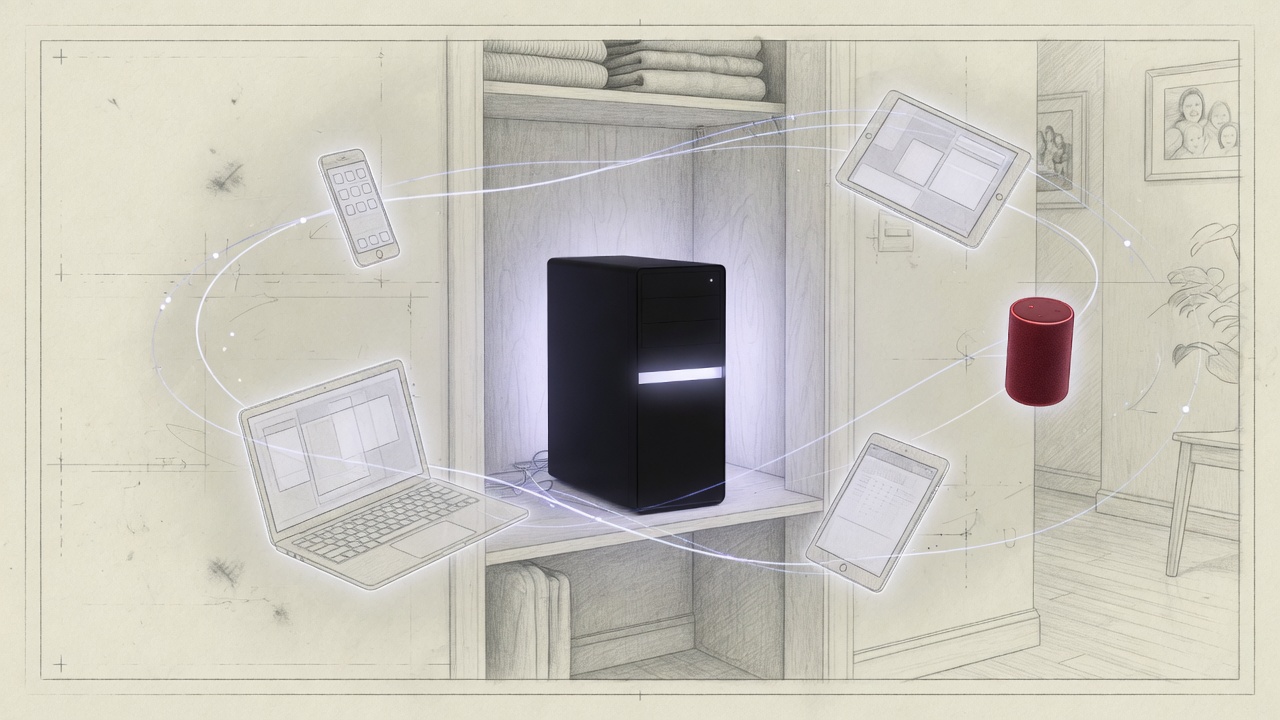
We spent decades moving away from mainframes. AI is pulling us toward them again — only this time the mainframe can live in your house, and you can be the one who owns it.
Not many people have a full version of this yet, but it is coming down the road — not already on every desk.
The original mainframe world
In the beginning, computing power was scarce and extremely expensive. A single mainframe sat in a climate-controlled room, and dozens of people shared it through dumb terminals. Those terminals had almost no intelligence of their own. They were windows. The real brain lived elsewhere.
You typed. The mainframe thought. The terminal displayed the result.
It was centralized, hierarchical, and efficient in its constrained way. Access was controlled. Creativity was gated. The machine belonged to the institution, not the individual.
Then the personal computer shattered that model.
The great decentralization
The PC revolution was a philosophical and technical rebellion. Every desk got its own processor, memory, and storage. Power moved from the center to the edge. You no longer needed permission to run a program — you just ran it.
That shift produced an explosion of software, creativity, and personal agency. Laptops, smartphones, and tablets continued the pattern: more devices, more local capability, less dependence on any single central machine.
For a long time it felt permanent. Compute would keep getting cheaper and more distributed until every device was powerful enough on its own.
AI is breaking that assumption.
Why AI changes the equation
Modern models are still heavy. Even smaller ones demand significant memory, power, and cooling if you want them genuinely useful rather than cute demos. Running a capable model on every device is wasteful and expensive — and the cloud alternative reintroduces the old mainframe problem in a new costume.
The powerful brain lives somewhere else, under someone else's control, on someone else's terms. Your data leaves the house. Latency appears. Policy decisions made in a distant office suddenly affect what your own computer is allowed to do.
So a third path is starting to come into view.
The home mainframe
Imagine a single always-on machine in your house — a quiet, powerful box in a closet or on a desk. It runs a strong local model. Not a toy. Capable of complex reasoning, long-context work, coding, research, personal knowledge, and conversation.
Your phone, laptop, tablet, and smart-home devices become terminals again.
They don't need to run the heavy model. They send requests, receive answers, and display results. The serious thinking happens in one place: your place.
That is the mainframe model returning, with one critical difference.
You would own the mainframe.
This is still rare. A handful of enthusiasts and labs can do pieces of it. A true household-scale version — always on, private, strong enough to be the default brain for every screen in the house — is mostly still ahead of us.
Why this is starting to make sense
Several trends are converging:
- Home computers and small form-factor servers keep getting more powerful while power use and noise drop.
- Models are being aggressively compressed. What required a data center a few years ago can increasingly run on high-end consumer hardware.
- Privacy and data sovereignty are real concerns for more people, not just specialists.
- Latency still matters. A local response feels different from a round-trip to a distant data center.
- The more capable the AI becomes, the more of your life it will touch. Keeping that capability inside your walls starts to feel less like preference and more like necessity.
In that future setup, your phone is no longer trying to be a full computer with its own AI. It becomes a high-quality window into the real computer at home. Your laptop is a more comfortable terminal. A smart speaker or a future pair of glasses simply queries the same local brain.
One powerful local intelligence. Many lightweight interfaces.
The psychological shift
When the intelligence lives on a machine you control, the relationship changes. You stop feeling like a temporary guest in someone else's system. The AI becomes part of your environment rather than a service you rent by the month. It can know your files, projects, preferences, and history without that knowledge being continuously exported.
It starts to feel less like using a product and more like living with a capable tool that belongs to the household.
That is closer to the original promise of personal computing than the current cloud-heavy reality.
Not a full return
This will not be a pure revival of 1970s mainframes. The home version will be more personal, more private, and more flexible. You will still run lighter models on devices when it makes sense. You will still use the cloud for scale and specialized hardware. The line between local and remote will stay blurry for a long time.
But the gravitational center is starting to shift. Instead of every device trying to be self-sufficient, and instead of everything defaulting to a distant server, a strong local core is beginning to look like the rational middle ground — even if not many people have a full version of this yet.
The quiet irony
We spent fifty years dismantling the mainframe model because we wanted power distributed to individuals. Now the demands of serious AI are pushing us back toward concentration of compute — only this time the concentration can happen at the scale of a single household.
The terminals are coming back.
The difference is that the mainframe can be yours.
And that might turn out to be one of the more important shifts in personal computing of the next decade.
Related: Shared Brain Chat — multi-model coordination over a local Markdown file — and the context rocket equation on why every LLM turn re-launches the whole payload.